
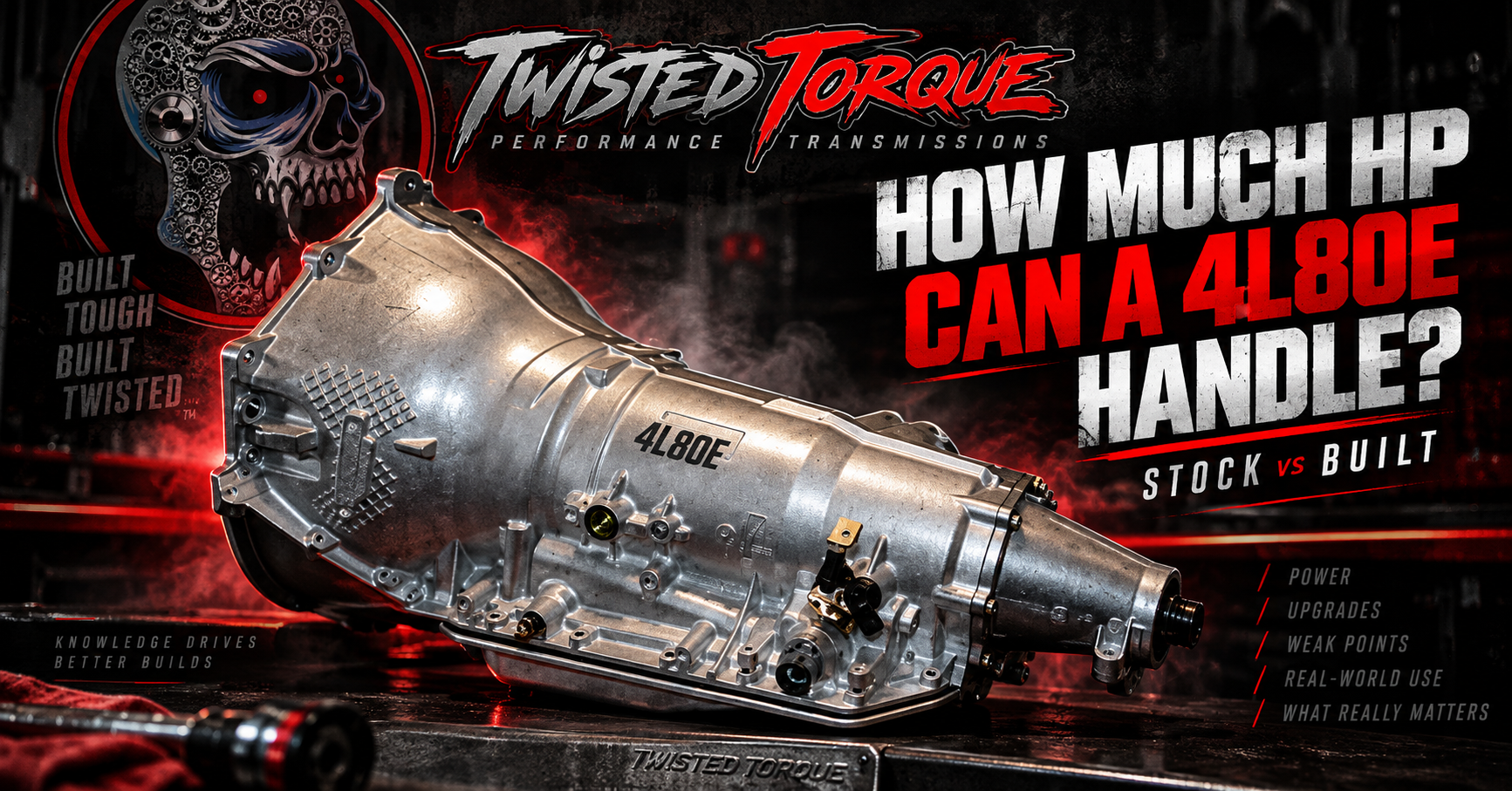
How Much Horsepower Can a 4L80E Handle? Stock vs. Built 4L80E
If you've spent any time researching the GM 4L80E, you've probably seen horsepower claims all over the place.
“A stock 4L80E will hold 800 HP.”
“You need billet shafts at 700 HP.”
“A built 4L80E will handle 1,500 HP.”
The problem is that horsepower alone doesn't tell us how hard a transmission is being worked.
A 600 HP street car on street tires is not the same transmission application as a 600 HP truck towing a trailer. A 750 HP car rolling into boost on the highway is not the same as a 750 HP drag car leaving hard on a sticky tire.
So how much horsepower can a 4L80E actually handle?
The answer depends on torque, vehicle weight, gearing, tire, converter, engine combination, shift calibration and how the vehicle is used.
Let's break it down.
🔧 THE 4L80E STARTED WITH A STRONG FOUNDATION
The 4L80E was never designed as a lightweight passenger-car transmission.
GM developed it as a heavy-duty electronically controlled four-speed automatic. Its basic gear ratios are:
1st Gear: 2.48:1
2nd Gear: 1.48:1
3rd Gear: 1.00:1
4th Gear: 0.75:1 Overdrive
The production transmission was rated by GM around 440 lb-ft of maximum engine torque in Chevrolet Performance documentation.
That factory rating is important, but it should not be confused with the ultimate strength of a performance-built 4L80E.
GM had to design the original transmission around production vehicles, warranty life, shift quality, towing, heat, emissions, manufacturing cost and thousands of miles of normal use.
Once we start building a 4L80E specifically for performance, we can address many of the components and hydraulic limitations that weren't designed around high-horsepower use.
⚠️ THERE IS NO MAGIC 4L80E HORSEPOWER NUMBER
This is the biggest thing to understand.
Torque breaks parts. Heat kills clutches. Vehicle weight adds load. Traction changes everything.
If you call us and say:
“My engine makes 650 HP. Which transmission do I need?”
650 HP gives us somewhere to start.
But we also want to know:
How much torque does it make?
How heavy is the vehicle?
What rear gear are you running?
What size tire?
Street tire, drag radial or slick?
Naturally aspirated, turbo, supercharger or nitrous?
Are you cruising it, towing with it, roll racing it or launching it at the track?
What converter are you running?
Those answers can change how we build the transmission.
WHAT STARTS TO MATTER AS 4L80E POWER GOES UP?
A performance 4L80E isn't just a stock transmission with different friction material and more line pressure.
As power and load increase, we start paying closer attention to several specific areas.
⚙️ CLUTCH CAPACITY
The clutch packs have to hold the torque being transferred through the transmission.
More power can require increased clutch capacity, better friction materials, correct steels, proper apply pressure and carefully set clutch clearances.
Simply stuffing additional frictions into a drum doesn't automatically make the transmission better.
The entire clutch system has to work together.
⚙️ HYDRAULICS & LINE PRESSURE
This is another area where internet advice gets oversimplified.
More line pressure is not automatically better.
The valve body, pump, pressure-regulator circuit, boost system, accumulators, converter circuit and clutch feeds all have to work together.
Sonnax has documented 4L80E pressure-control problems capable of creating extreme uncontrolled line pressure, which can actually damage clutch pistons, drums and even transmission cases.
The goal of a performance calibration isn't:
MAXIMUM PRESSURE EVERYWHERE.
The goal is:
ENOUGH CONTROLLED APPLY PRESSURE WHERE AND WHEN THE TRANSMISSION NEEDS IT.
We want the clutches applied correctly and the shifts positive under power without unnecessarily beating the transmission to death.
⚙️ THE INTERMEDIATE SPRAG
The intermediate sprag is another important part of the 4L80E story.
Earlier 4L80E units used an older intermediate sprag configuration, while later transmissions received the larger 34-element intermediate sprag.
The later setup is generally preferred for performance use, but even the stronger sprag isn't indestructible.
Shift calibration matters here too.
An unnecessarily violent 1-2 shift can shock the intermediate components instead of protecting them.
At extreme power levels, completely different drum and sprag configurations are available.
Again:
Harder isn't always stronger.
A transmission that bangs into every gear at part throttle isn't automatically a better-built transmission.
🔩 INPUT SHAFT
Eventually we reach a point where the factory hard parts themselves become part of the conversation.
The input shaft is a perfect example.
Sonnax identifies input-shaft failure as a known concern in performance and heavy-duty 4L80E/4L85E applications.
For serious performance builds, 300M heavy-duty input shafts are available.
Sonnax recommends its 300M 4L80E input shaft for applications up to approximately 1,000 HP.
And above that?
They offer an Aermet Extreme Duty input shaft for applications exceeding 1,000 HP.
That tells you something important about building these transmissions:
There is a point where hydraulic and clutch upgrades aren't enough.
Eventually, the hard parts have to change too.
🔩 MAIN SHAFT
The main shaft follows a similar progression.
For high-performance builds, 300M heavy-duty main shafts are available to replace the factory component.
For extreme applications above that level, Aermet main shafts are available.
Sonnax has reported its Extreme Duty Aermet main shaft being successfully used in applications exceeding 3,500 HP.
But let's make something very clear:
THAT DOES NOT MEAN A 4L80E WITH THAT SHAFT IS A 3,500 HP TRANSMISSION.
It means that individual component has survived applications at that level.
The transmission is a system.
The strongest input shaft on earth doesn't magically strengthen every clutch, drum, sprag, planetary, hub, converter and hydraulic circuit around it.
That's why we don't rate a transmission based on the strongest part inside it.
🔩 FORWARD CLUTCH HUB
The forward clutch hub becomes another area of concern as power increases.
Heavy-duty forged replacements increase strength over the OE component.
At extreme levels, aftermarket systems change the hub and clutch architecture even further.
This is another reason there can be a massive difference between:
“rebuilt 4L80E”
and
“high-horsepower 4L80E.”
They may share the same case and transmission family, but what's happening inside them can be completely different.
⚙️ OVERDRIVE & HIGH-LOAD OPERATION
The 4L80E's overdrive system deserves attention too.
Sonnax has documented overdrive roller-clutch failure under severe-use conditions, particularly where heat and high load become factors.
This is why lubrication, converter operation, hydraulic calibration and cooling matter just as much as the parts everybody likes putting on a build sheet.
🧊 HEAT CAN KILL AN EXPENSIVE TRANSMISSION
You can spend thousands of dollars building a transmission and still destroy it with inadequate cooling.
Higher-stall converters can create additional heat.
Heavy vehicles create more load.
Towing creates sustained load.
Repeated hard driving creates heat.
Restricted cooler lines make everything worse.
A performance transmission needs a clean, unrestricted and properly sized cooling system.
If the previous transmission failed and sent clutch material or metal through the cooler, don't assume flushing automatically makes a contaminated cooler safe.
SO HOW MUCH HORSEPOWER CAN A 4L80E ACTUALLY HANDLE?
Here's a more useful way to look at it.
STOCK TO MILD PERFORMANCE
A healthy production 4L80E already starts with a strong heavy-duty architecture.
For mild-power street applications, the factory hard parts can provide an excellent foundation when they're in good condition and the transmission is properly serviced and calibrated.
450-650 HP
Now clutch capacity, intermediate sprag configuration, pump condition, valve-body calibration, converter selection and cooling become increasingly important.
This is where a properly built performance 4L80E begins separating itself from a basic stock rebuild.
650-850 HP
Now we're asking considerably more from the transmission.
Vehicle weight, torque delivery, traction and intended use become increasingly important.
Depending on the application, stronger hard parts and more substantial clutch and hydraulic modifications become appropriate.
A heavy boosted vehicle or hard-launching drag car can require a different transmission than a lighter street car making the same horsepower.
850-1,000 HP
This is serious 4L80E territory.
At this level, we are looking beyond basic clutch and valve-body modifications and paying very close attention to:
Input shaft
Main shaft
Forward clutch hub
Intermediate sprag and drum
Clutch capacity
Pump
Valve body
Converter
Cooling
Vehicle weight
Traction
Launch characteristics
1,000+ HP
Now we're talking about an extreme-duty 4L80E, not a typical street performance rebuild.
Even Sonnax divides its 4L80E performance recommendations into under-1,000 HP and over-1,000 HP configurations, with the higher-power architecture moving from 300M components toward Aermet Extreme Duty parts.
At this point, the exact vehicle combination matters more than a number printed on a website.
🏁 REAL-WORLD EXAMPLE: 550 HP 383 CHEVELLE
Let's say you've got a 1967 Chevelle with a naturally aspirated 383 making around 550 HP.
Can a properly built 4L80E handle it?
Absolutely.
But we still wouldn't select the transmission based on 550 HP alone.
We'd want to know:
Camshaft specs
Estimated torque
Rear gear
Rear tire diameter
Street tire, drag radial or slick
Vehicle weight
Carbureted or EFI
Mostly street or street/strip
How hard the car will be launched
Then we'd match the transmission and converter to the actual combination.
A 550 HP Chevelle cruising to shows and occasionally getting hammered on isn't the same application as a 550 HP Chevelle leaving at the track every weekend on a sticky tire.
⚙️ WHAT ABOUT THE TORQUE CONVERTER?
Don't spend thousands building the transmission and then treat the converter like an afterthought.
Converter selection affects:
Launch characteristics
Engine RPM
Heat
Street manners
Shift recovery
Lockup operation
How effectively the engine stays in its powerband
We don't believe every 600 HP car needs the same stall.
Camshaft, engine torque curve, rear gear, tire size, vehicle weight and intended use all matter.
The converter should be matched to the combination.
🔥 TWISTED TORQUE 4L80E PERFORMANCE LEVELS
At Twisted Torque, we don't use one 4L80E build for everything.
Our performance lineup is divided by power level and intended use so we're not selling the same transmission to a mild street car and a serious boosted combination.
🔥 Twisted Street™ 4L80E
Rated Up To 450 HP
Designed for street-driven performance applications that need the strength and overdrive capability of the 4L80E without requiring an extreme hard-part package.
⚙️ Twisted Pro™ 4L80E
Rated Up To 650 HP
Designed for modified street cars, muscle cars, stroker combinations, LS swaps and stronger naturally aspirated applications.
☠️ Twisted Punisher™ 4L80E
Rated Up To 850 HP
Designed for serious street/strip combinations, boost, nitrous, high-output engines and applications where additional transmission capacity and strength are required.
🔥 Twisted Executioner™ 4L80E
850-1,000 HP Applications
Our highest-level 4L80E package for combinations requiring serious hard-part upgrades, increased clutch capacity and high-power calibration.
Horsepower ratings are application guidelines, not a substitute for properly matching the transmission to the vehicle.